
25 min read ·
A Practical Guide to Emerging Hardware Companies and Products
Six dimensions cover much of the difference between an interesting listing and a business capable of delivering lasting value.
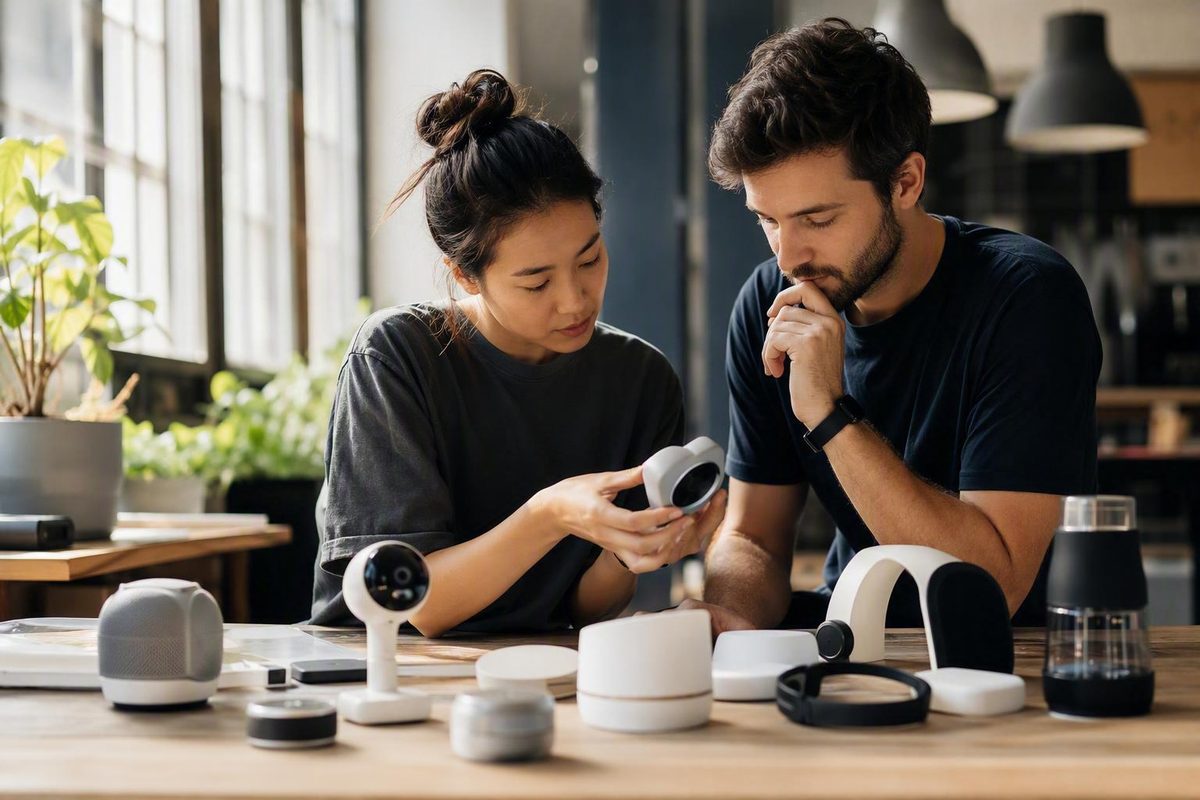
“Gadget startups” is a convenient search term, but it is not a precise business category. It can refer to a connected garden sensor, a wearable posture tracker, a crowdfunded desktop display, a modular laptop company, or an industrial robot. Although all may involve electronics, they do not share the same customers, capital requirements, development cycles, manufacturing risks, or routes to market.
That makes a definitive ranking misleading. Directory visibility, crowdfunding performance, reported funding, and editorial inclusion can help uncover companies and product concepts. None proves that a device works as promoted, can be manufactured reliably, has been delivered, or supports a durable business.
This guide is therefore an evaluation framework illustrated with source-visible examples—not a current ranking or verified shortlist of active gadget companies. The supplied directory and crowdfunding extracts do not provide a common capture date, and most examples lack current first-party verification. Volatile campaign percentages and time-remaining figures have consequently been omitted.
A better approach is to identify the kind of entity under review, organize examples by use case, separate promotional claims from verified evidence, and evaluate each opportunity across customer demand, product maturity, manufacturing readiness, delivery history, and business-model durability.
What Counts as a Gadget Startup?
For this guide, a gadget startup is an early-stage company whose core offering includes a physical device. Software may be central to the experience—through an application, cloud service, machine-learning model, or developer platform—but the customer still needs a manufactured product.
The category commonly includes:
- Connected consumer accessories
- Wearables and personal devices
- Smart-home and home-security products
- Health and fitness hardware
- Mobility and automotive accessories
- Sports equipment
- Garden and environmental monitors
- Desktop devices
- Imaging, authentication, and sensing tools
Directories apply the term inconsistently. BetaList, for example, places environmental sensors, keyboards, smart lighting, connected-car products, wearables, security accessories, and some apparently software-oriented listings on the same gadget page. Its related topics include mobile devices, consumer goods, wearables, home and garden, and home automation. BetaList’s hardware-gadgets directory is therefore useful for discovery, not for establishing legal status or commercial maturity.
To keep comparisons clear, this article uses six labels:
| Label | Meaning |
|---|---|
| Incorporated startup | An early-stage legal company with evidence of current operations and a physical product at its core |
| Directory-listed company | An entity described as a company or startup by a third-party directory, without assuming that the listing is current or verified |
| Crowdfunding campaign | A time-bounded fundraising or pre-sale project presented by a creator on a crowdfunding platform |
| Standalone product | A named device or concept whose listing does not establish that it is backed by a distinct, active company |
| Industrial-hardware company | A business building physical systems primarily for commercial, industrial, government, or infrastructure buyers |
| Established corporation | A mature electronics company that may appear on a startup or innovation list but does not fit a conventional early-stage definition |
These distinctions matter because a product page is not necessarily a company record. A Kickstarter creator may be an individual, an informal team, an existing corporation, or a newly created legal entity. A BetaList entry may describe a product that is active, dormant, acquired, discontinued, or never released. Neither type of listing automatically establishes incorporation, current operations, delivery, or commercial availability.
The boundaries become even more important beyond consumer devices. Robots, semiconductors, chip-cooling systems, energy infrastructure, quantum hardware, and autonomous vehicles are adjacent hardware categories, but they should not be treated as interchangeable gadget businesses. Their buyers may be procurement teams rather than individual consumers. Their development can involve specialized facilities, long qualification periods, on-site deployment, regulation, and substantially different capital needs.
This guide presents representative, source-visible examples, not a comprehensive market map or ranking. Inclusion means only that an example helps illustrate a product category, entity type, or diligence issue.
Representative Gadget Concepts by Use Case
The following examples show the range of products associated with gadget directories and crowdfunding. Their descriptions come from the relevant listing or campaign, not from independent testing. No common source-capture date was available, so current status remains unverified.
| Product or project | Entity label | Category | Intended use described by the source | Evidence limitation |
|---|---|---|---|---|
| TinyTemp | Standalone product | Home and environmental monitoring | BetaList describes temperature and humidity history with instant alerts | Current availability, incorporation, accuracy, delivery, and operating status are not established |
| Dripio | Standalone product | Garden automation | BetaList describes smart watering technology for gardens | No current status, pricing, technical validation, or customer evidence is supplied |
| Mevics | Standalone product | Wearable health and activity | BetaList describes a wearable tracker for posture and physical activity | Performance, medical value, availability, and company status are not verified |
| Dride | Standalone product | Connected mobility accessory | BetaList describes a connected dashcam with safety alerts and applications | Independent safety, reliability, shipping, and active-support evidence is not supplied |
| immurok | Crowdfunding campaign | Security and authentication | The Kickstarter creator describes a wireless fingerprint-authentication key for desktop platforms | Security, compatibility, delivery, and product-quality claims are not independently established |
| TICKEY | Crowdfunding campaign | Desktop display | Its creator describes a customizable color e-paper display | Campaign visibility does not verify manufacturing readiness, fulfillment, or continuing software support |
| PixelMug S1 Series | Crowdfunding campaign | Interactive drinkware | Its creator describes a mug with a pixel display, games, music-reactive visuals, an application ecosystem, and an open SDK | Durability, safety, application longevity, and delivery are not established |
| TIMECAPSULE G3 | Crowdfunding campaign | Desktop companion | Its creator describes clock, alarm, reminder, Bluetooth-speaker, and historical-content functions | Feature descriptions and delivery expectations remain campaign-supplied |
| NIXUS | Crowdfunding campaign | Sports hardware | Its creator says the device restores tennis and padel balls to full pressure using patented measuring technology | Performance and patent statements are creator claims, not independent findings |
The table reveals several recurring product patterns.
Monitoring and automation products such as TinyTemp and Dripio turn environmental conditions into alerts or actions. Their value depends on more than a functioning sensor. Buyers may care about installation, battery life, connectivity, notification reliability, application quality, and whether the device continues working if a cloud service changes.
Wearable and mobility concepts such as Mevics and Dride combine physical hardware with software interpretation. A posture tracker must do more than collect motion data; it must produce feedback users find understandable and useful. A connected dashcam raises additional questions about storage, application compatibility, data handling, mounting, heat exposure, and continuing support.
Authentication hardware such as immurok warrants particularly demanding scrutiny. A promotional description can explain the intended function, but it does not establish resistance to attack, biometric reliability, recovery procedures, platform support, or safe credential handling.
Display-centered products such as TICKEY, PixelMug, and TIMECAPSULE G3 show how gadgets increasingly combine physical form with entertainment, personalization, reminders, applications, or content. That combination can create utility, but it also expands the support burden.
NIXUS represents sports-related hardware, where a consumer benefit may be easy to demonstrate visually. Even so, a compelling demonstration is not equivalent to repeatable real-world performance. Pressure-restoration claims, patent status, durability, operating cost, and compatibility with different balls require separate verification.
The supplied Kickstarter Gadgets discovery page reported 870 projects, while only 12 campaigns appeared in the extract. Because the capture date was unavailable, changing funding percentages and countdowns cannot be responsibly reproduced. The visible projects also cannot represent the full category or establish that their creators are incorporated startups, that the products have shipped, or that campaigns achieved sustainable demand.
None of these examples should be assumed to be currently available, delivered, independently tested, incorporated, or commercially viable. They are examples of the concepts and promotional narratives found in gadget-discovery channels.
Consumer Gadgets, Industrial Hardware, and Established Electronics
A smart mug and an infrastructure-inspection robot are both physical products, but putting them in one undifferentiated startup ranking obscures more than it reveals.
A consumer-gadget company may sell directly to individuals through retail, e-commerce, or crowdfunding. Its challenges can include price sensitivity, industrial design, seasonal demand, returns, customer support, rapid product cycles, and the cost of acquiring individual customers.
An industrial-hardware business may sell larger systems to utilities, manufacturers, transportation operators, or government agencies.
Editorial electronics lists often combine both models with established brands and enabling technologies. Failory’s electronics watch list includes Nothing, Eight Sleep, SimpliSafe, Framework, and Dreame Technology. It attributes smartphones and earbuds to Nothing, a temperature-adjusting sleep-tracking mattress cover to Eight Sleep, wireless home-security devices to SimpliSafe, modular consumer electronics to Framework, and cleaning or personal-care devices to Dreame Technology. Its product descriptions and reported funding totals are third-party claims rather than proof of revenue, adoption, profitability, or quality. The same list includes Bose, which it reports was founded in 1964, demonstrating why an editorial “startup” list should not be treated as a strict early-stage classification.
Framework is a useful example of differentiation beyond novelty. Failory describes its focus as repairable and upgradeable modular electronics, including laptops. That proposition can be investigated through concrete questions:
- Which parts can users replace?
- How long will replacement modules remain available?
- Does modularity materially extend product life?
- How does it affect size, performance, price, and warranty handling?
- What inventory complexity follows from maintaining compatible modules?
A clear product philosophy can be valuable, but execution determines whether it produces durable customer value.
Gecko Robotics provides an even clearer contrast with consumer gadgets. TopStartups.io describes Gecko Robotics as a Pittsburgh robotics and hardware company founded in 2013 that builds robots for hazardous infrastructure inspection. The directory also lists a 101–200 employee range, a $125 million Series D in 2025, a $1.2 billion valuation, and Founders Fund and Y Combinator as investors. These remain directory-reported details, not independently verified facts.
For an industrial company of this kind, the relevant diligence questions differ from those used for a consumer accessory:
- Can the system operate reliably in the specified inspection environment?
- What training and integration does a customer need?
- How does the company document measurement quality?
- Is revenue based on equipment sales, inspections, software, service contracts, or a combination?
- How long is the procurement cycle?
- What maintenance, field support, and liability exposure accompany deployment?
- Does scaling require more machines, more operators, greater software capacity, or all three?
Semiconductors, quantum systems, chip cooling, energy infrastructure, and autonomous vehicles deserve similar separation. Calling all of them gadgets makes comparison easier only at the expense of analytical usefulness.
The practical rule is simple: compare businesses first by customer, deployment setting, product architecture, and capital model. Only then compare differentiation, traction, funding, or growth.
How to Evaluate a Gadget Startup Without Relying on Hype
A credible evaluation should replace a single popularity ranking with a multidimensional scorecard. Six dimensions cover much of the difference between an interesting listing and a business capable of delivering lasting value.
| Dimension | Questions to investigate | Weak signal | Stronger signal |
|---|---|---|---|
| 1. Company status | Is there an active legal and operating company? Who founded it, where is it based, and when was it last active? | A directory profile or old product page | Verifiable identity, named team, current first-party site, and recent operating update |
| 2. Customer evidence | Who has the problem, and are customers paying to solve it? | Likes, press mentions, survey enthusiasm, or wait-list registrations | Paid orders, repeat demand, credible usage, low avoidable returns, and observed willingness to pay |
| 3. Product maturity | Is the device a concept, prototype, pre-production unit, campaign, shipping product, or discontinued product? | Renderings or a controlled demonstration | Units tested in realistic use, with stage-appropriate evidence and documented limitations |
| 4. Manufacturing readiness | Are materials, components, suppliers, tolerances, tooling, assembly, quality, packaging, and compliance understood? | A working one-off prototype | Production-relevant design, supplier commitments, pilot results, quality controls, and contingency plans |
| 5. Delivery record | Were promised products delivered as expected, and what happened when problems arose? | An estimated shipping month | Shipment evidence, transparent delay updates, responsive support, appropriate refunds, and workable warranty terms |
| 6. Business-model durability | Can the company support the product economically over its useful life? | Attractive retail price without a cost model | Credible margin assumptions, support reserves, clear recurring costs, and plans for software and end-of-life obligations |
Company status should be checked rather than inferred. Look for a verifiable legal entity where relevant, a current headquarters, named founders, an active first-party website, and a recent operating update. A founding year in a directory can help locate other records, but it should not be the final evidence.
Customer evidence should distinguish behavior from attention. Social engagement can indicate that a concept is visually compelling. A large email list may show interest. Neither establishes that people will pay a sustainable price, continue using the device after novelty fades, or recommend it after encountering setup and maintenance demands.
Paid orders are more meaningful, but they also require context. Were purchases refundable? Were they made at a heavily discounted campaign price? Did customers reorder accessories or maintain a subscription? How many units were returned? For a business product, did a pilot lead to broader deployment?
Product maturity needs an explicit label. Common stages include:
- Concept or rendering
- Visual prototype
- Functional prototype
- Pre-production prototype
- Crowdfunding or pre-order campaign
- Pilot-production unit
- Shipping commercial product
- Discontinued or unsupported product
A polished video can make these stages look similar. They are not. A single prototype assembled by engineers may demonstrate feasibility while remaining far from a product that factory workers can build repeatedly within target cost and quality limits.
Manufacturing readiness is not simply the name of a factory. Teams should identify single-source components and determine what happens if prices rise, lead times change, or a supplier stops producing a part.
Delivery evidence should cover promised and actual shipping dates, delays, refund handling, customer support, warranty terms, replacement inventory, and continuing software support.
Business-model durability requires more than an assumed retail margin. Possible structures include:
- One-time hardware sales
- Subscriptions
- Consumables or refills
- Accessories and replacement parts
- Paid companion applications
- Cloud storage or processing
- Enterprise service contracts
- Developer ecosystems or marketplace fees
No model is automatically superior.
Connected gadgets also require focused diligence around privacy, cybersecurity, repairability, and end-of-life support:
- What data does the device collect, and where is it processed?
- Can essential functions operate without an account or cloud connection?
- How are software updates authenticated and delivered?
- What happens if the company shuts down the service?
- Can batteries, screens, sensors, and other failure-prone parts be replaced?
- How long are firmware, applications, and integrations expected to receive support?
- Who pays for warranty replacements, returns, and security maintenance?
Promoted placements, campaign badges, editorial watch-list inclusion, funding totals, and valuations can identify entities worth investigating. They are discovery signals—not proof of product quality, customer satisfaction, investment merit, or operational strength.
From Customer Problem to a Useful Prototype
Hardware founders should resist beginning with tooling, inventory, or a feature-rich industrial design. The first task is to define a customer problem precisely.
A useful discovery process answers four questions:
- Who is the intended user or buyer?
- What recurring problem does that person experience?
- What workaround is used today?
- Why would a new device be materially better than that workaround?
“People want to monitor their homes” is too broad. A testable statement identifies a particular user, condition, consequence, and current behavior. The same principle applies to wearables, sports products, security keys, and desktop devices. Specificity helps the team determine what the prototype must prove and which features can wait.
A prototype should test three different propositions:
- Feasibility: Can the device perform the required function?
- Desirability: Does it solve a problem customers care enough about to change behavior or pay?
- Manufacturability: Is there a plausible route to making it repeatedly with suitable components, materials, processes, and cost?
These questions require different prototypes.
| Prototype type | Primary purpose | What it should test |
|---|---|---|
| Visual prototype | Appearance and physical concept | Shape, proportions, layout, styling, perceived size, and presentation |
| Functional prototype | Usability and technical behavior | Core performance, controls, ergonomics, setup, real-world interaction, and durability assumptions |
| Pre-production prototype | Manufacturing preparation | Production-relevant materials, tolerances, assembly, processes, cost, test methods, and repeatability |
A visual model can help a potential customer react to size and form, but it should not be presented as evidence that the internal system works. A functional prototype can test the user experience, but it may rely on oversized boards, hand wiring, expensive components, or 3D-printed enclosures. A pre-production unit should move closer to the intended bill of materials and factory processes.
Potential customers should interact with a functional prototype as early as practical. Rather than asking them to invent features or design the product, observe what they do:
- Can they understand setup without extensive explanation?
- Do they hold, wear, mount, or position the device as expected?
- Is it too large, heavy, bright, dim, loud, fragile, or awkward?
- Do the controls and indicators make sense?
- Does the device fit into its intended environment?
- Does it withstand realistic handling?
- Does the user return to it after the first interaction?
- Does it remove the stated problem or merely add another task?
Rev: Ithaca Startup Works’ prototyping guidance recommends substantial customer discovery before prototyping, followed by placing a working model in potential customers’ hands to assess feasibility, desirability, and eventual manufacturing potential. Rev also recounts a connected cigarette-carton project that used off-the-shelf electronics but was abandoned when appropriately sized production materials proved too expensive. That is an attributed accelerator account rather than a universal research finding, but it illustrates the gap between a technically successful demonstration and a commercially plausible product.
Observation should eventually lead to a willingness-to-pay test. Compliments are inexpensive. Survey respondents can express enthusiasm without making a tradeoff. Wait-list registrations may help recruit testers, but they do not reveal whether someone will buy at a price that supports manufacturing, freight, support, returns, and warranty obligations.
Useful tests can include a refundable deposit, a paid pilot, a clearly priced reservation, or a realistic purchase decision after hands-on use. The form should match the market and development stage. The objective is to discover whether interest survives contact with an actual price.
Prototype components can create false confidence. A development board may be readily available but too large or costly for the final enclosure. A 3D-printed material may work for demonstrations but behave differently from the intended production material. A hand-assembled cable arrangement may be impossible to build efficiently. Teams should track every prototype shortcut and assign a plan for replacing it with a production-suitable alternative.
The Production-Readiness Gates Every Hardware Team Needs
A functional prototype is not proof of readiness for mass production. It shows that one implementation can work under some conditions. Manufacturing asks a harder question: can many units be built consistently, tested efficiently, packaged safely, delivered economically, and supported after sale?
A disciplined progression uses explicit gates:
- Production-material validation
- Design-for-manufacturing review
- Supplier selection and component confirmation
- Compliance assessment
- Pre-production testing
- Pilot run
- Scaled production
At the first gate, replace prototype-only materials and components wherever possible. Verify performance under relevant temperature, moisture, vibration, wear, charging, storage, and transport conditions. Confirm that selected parts are commercially obtainable in the required form and that alternatives exist for critical components.
The design-for-manufacturing review should ask:
- Can the part count be reduced?
- Can fasteners, cable routes, connectors, or adhesives be simplified?
- Are shapes compatible with the intended process?
- Are tolerances necessary and achievable, or merely inherited from a prototype?
- Are materials available in bulk from credible suppliers?
- Can assembly steps be reduced or mistake-proofed?
- Can each unit be tested without slow manual procedures?
- Can the process produce repeatable results across workers, shifts, tools, and material batches?
- Can the product be repaired or disassembled without unnecessary damage?
Manufacturing processes offer different advantages. Injection molding is commonly considered for repeatable volume production of suitable parts; CNC machining is useful where precision and machinable materials matter; additive manufacturing offers flexibility for prototypes, complex geometries, and some production applications. There is no universal volume or price threshold. Geometry, material, finish, tooling expense, lead time, tolerance, expected demand, and design stability all influence the choice.
Avid Product Development’s prototype-to-production guidance distinguishes visual, functional, and pre-production prototypes and recommends production-relevant materials, design-for-manufacturing work, documented quality controls, and pilot runs before scaling. It describes pilot production as a test of manufacturability, assembly, suppliers, packaging, quality assurance, and supply-chain readiness. Because Avid sells related services, its recommendations are best treated as practical commercial guidance rather than proof that every company needs an external specialist.
Hardware teams generally have three manufacturing models:
| Model | Potential advantages | Potential disadvantages |
|---|---|---|
| In-house production | Direct process control, faster internal learning, and protection of specialized know-how | High capital needs, facility and staffing demands, maintenance burden, and limited initial process breadth |
| Partial outsourcing | Control of critical steps while using specialist suppliers for others | More coordination, logistics, supplier interfaces, and responsibility for final integration |
| Complete contract manufacturing | Access to established equipment, labor, sourcing, and process experience | Less direct control, partner dependency, minimum-order constraints, and possible knowledge-transfer risk |
The right choice depends on capital, internal expertise, product complexity, intellectual property, expected volume, quality requirements, strategic objectives, and whether manufacturing itself is central to the company’s advantage. Product QuickStart’s manufacturing overview outlines the same broad options and favors contract manufacturing for many inventors, but the publisher sells product-development and manufacturing services. Its preference should not be treated as a universal conclusion.
A manufacturing-partner review should cover:
- Experience with the relevant materials and processes
- Quality systems and process documentation
- Available capacity and realistic lead times
- Engineering communication and change control
- References for comparable work
- Component sourcing and traceability
- Handling of nonconforming units
- Intellectual-property and tooling arrangements
- Contingency plans for supplier or equipment failure
- Willingness to support a small pilot before a larger commitment
- Responsibility for packaging, freight preparation, and final testing
A pilot run is not simply a smaller mass-production order. It is an experiment designed to expose weaknesses while changes remain manageable. The team should define in advance what the pilot must demonstrate: assembly time, defect patterns, test coverage, packaging performance, supplier coordination, documentation quality, and process repeatability.
Quality controls may include:
- CAD and engineering reviews
- Incoming-component inspection
- Prototype and first-article inspection
- Pre-production functional and stress tests
- Documented assembly procedures
- Calibration and test-fixture validation
- Yield and defect tracking
- Root-cause analysis
- Repeatability checks across multiple units
- Packaging and transport testing
- Traceability for critical components and revisions
Standards and approvals can affect market entry, but requirements cannot be assigned from a generic gadget label. Avid’s general manufacturing guidance identifies ISO-related controls, CE marking, and FDA requirements as examples that may matter; radio-connected products and battery-powered devices may raise additional product-specific questions. A security accessory, wellness wearable, medical device, radio-connected sensor, and children’s product may face materially different requirements. Product-specific regulatory analysis should therefore occur before design choices and launch promises become difficult to change.
What Crowdfunding Can—and Cannot—Prove
It can also convert uncertainty into a large set of obligations before manufacturing is ready.
The first distinction is between reward or product crowdfunding and equity crowdfunding. Product crowdfunding commonly offers nonfinancial rewards such as early access, a discounted device, or a special edition rather than ownership. Equity crowdfunding exchanges capital for ownership interests and introduces securities, disclosure, governance, valuation, and investor-relations considerations. J.P. Morgan’s overview of product and equity crowdfunding describes these differences and identifies capital, awareness, community building, feedback, and a signal of market interest as potential benefits.
Those obligations can become more difficult if a campaign attracts substantially more orders than expected.
Tangible consumer products may suit reward crowdfunding because they can often be shown in a short demonstration. A viewer can understand the intended benefit of a smart display, kitchen device, sports accessory, or interactive mug. Narrowly targeted business equipment may have too few relevant buyers for a broad campaign, while highly regulated products may be difficult to promote responsibly before their claims and market-entry path are resolved. This is a question of demonstrability and audience fit, not evidence of a category-wide success rate.
Campaign metrics must be interpreted carefully. Percentage funded is incomplete without:
- The original funding goal
- Absolute dollars raised
- Number of backers
- Campaign start and end dates
- Average contribution or reward price
- Expected delivery date
- Shipping charges and geographic coverage
- Updates after the campaign
- Actual delivery date
- Delays, cancellations, refunds, and unresolved complaints
A campaign at a high percentage of a small goal may have raised less money than one at a lower percentage of a much larger goal. Neither percentage reveals whether pricing accounts for tooling, compliance, freight, duties, failed units, returns, support, and warranty costs.
Overfunding can increase risk. Demand arriving faster than operational capacity can magnify rather than solve manufacturing weaknesses.
Crowdfunding can still provide meaningful evidence.
Crowdfunding may also affect later venture financing, but the relationship is not mechanically positive. A model published in Management Science examines a startup, a crowdfunding platform, and competing venture investors with different beliefs. Under the model, a successful campaign can cause investors to reconsider a startup they previously declined. Under other modeled conditions, investors may wait for more information, crowdfunding may reduce the startup’s subsequent funding need, or campaign failure may deter investment. These are theoretical mechanisms, not observed outcomes for the gadget projects discussed here, and they depend on the model’s assumptions. The crowdfunding and venture-capital model should not be used to predict financing for a particular company.
The bounded conclusion is that crowdfunding can provide capital, feedback, visibility, community, and a limited demand signal. It does not by itself prove product-market fit, manufacturing readiness, successful delivery, product quality, or sustainable demand.
Building an Evidence-Based Shortlist—and Approaching Investors
A useful gadget-startup shortlist should function like a date-stamped diligence database, not a collection of impressive names.
At minimum, record:
| Field | What to capture |
|---|---|
| Entity type | Incorporated startup, directory listing, campaign, standalone product, industrial company, or established corporation |
| Company status | Active, uncertain, acquired, discontinued, or not verified |
| Location | Headquarters or creator location, with the source identified |
| Founding year | Reported year and verification status |
| Product category | Consumer, home, health, sports, security, industrial, component, or another meaningful segment |
| Development stage | Concept, prototype, pre-production, campaign, pilot, shipping, or discontinued |
| Availability | Region, channel, stock or pre-order status, and verification date |
| Price | Retail, campaign, subscription, consumable, or service pricing |
| Funding source | Bootstrapping, reward crowdfunding, equity crowdfunding, venture funding, debt, or unknown |
| Delivery record | Promised dates, actual dates, delays, refunds, and support evidence |
| Last verification date | When the underlying pages and records were checked |
If a source-capture date is unavailable—as with the examples in this guide—record it as not supplied rather than implying freshness. Current status should remain unverified until checked against first-party information or other suitable evidence.
Every material claim should also carry an evidence label:
- First-party: stated by the company or creator
- Campaign-supplied: presented on a crowdfunding campaign
- Third-party directory-reported: supplied by a listing or editorial database
- Independently verified: corroborated through credible testing, records, or multiple reliable sources
These labels prevent subtle errors. A directory’s “founded in” field should not become an unqualified fact. A creator’s patent or performance statement should not become an independent technical conclusion. A funding announcement should not become evidence of revenue. A testimonial should not become a representative measure of customer satisfaction.
For purchase or investment decisions, prioritize evidence in roughly this order:
- Current first-party company and product information
- Campaign updates and documented shipment history
- Regulatory or certification records where relevant
- Credible independent product testing
- Customer evidence with clear context
- Reliable reporting and databases
- General directories, watch lists, and discovery pages
Crowdfunding records should be normalized rather than sorted by percentage funded. Capture the goal, amount raised, backer count, campaign dates, reward price, promised delivery, actual delivery, delays, refunds, and continuing support. This turns a promotional metric into an operational record.
Founders approaching investors should make the evidence chain equally clear. A useful hardware pitch explains:
- The specific customer problem
- The distinctive insight behind the product
- Why hardware is necessary rather than ornamental
- What has been built and tested
- What customers have actually done
- What remains technically uncertain
- The manufacturing model and major suppliers
- Expected unit-economics assumptions
- Compliance and certification risks
- Support, warranty, privacy, and software obligations
- The exact milestone the new capital will finance
The milestone should be concrete: completing a pre-production design, validating a key component, running a pilot, obtaining a required approval, proving a target yield, or converting paid trials into repeatable orders. “Scale” is not a useful milestone if the underlying production process remains unproven.
Investor fit should be evaluated just as carefully as product fit. Lunera describes itself as an early-stage partner for technical founders and publicly highlights developer tools, data infrastructure, applied AI, and foundational business systems. Its supplied first-party page does not identify gadgets or hardware as an investment focus, but it also does not state that hardware is excluded. Founders should not interpret its broad technical positioning or open submission policy as evidence of hardware investment appetite. Lunera’s stated focus and pitching instructions should be assessed on their own terms.
The goal is not to find a definitive list. It is to build a repeatable method: identify the entity type, verify current status, distinguish creator claims from independent evidence, and assess demand, product maturity, manufacturing readiness, delivery history, and business-model durability. Directories and campaigns are useful starting points. Repeatable production, reliable support, and evidence of lasting customer value are substantially stronger indicators of business quality than visibility or promotional momentum alone.
Frequently Asked Questions
What is considered a gadget startup?
A gadget startup is generally an early-stage company whose main offering includes a physical device. It may sell a wearable, smart-home product, connected accessory, security device, mobility accessory, sports product, health device, or desktop tool.
The label should not automatically be applied to every crowdfunded product or directory entry. Verify that an active company exists, identify its development stage, and separate consumer gadgets from industrial robots, components, energy systems, quantum hardware, and established electronics corporations.
Which gadget products and projects are represented in current directories and crowdfunding listings?
The source-visible examples in this guide include TinyTemp and Dripio for home or garden monitoring, Mevics for posture and activity tracking, Dride for connected-dashcam functions, immurok for fingerprint authentication, TICKEY for a customizable e-paper display, PixelMug and TIMECAPSULE G3 for interactive desktop products, and NIXUS for sports hardware.
These are examples from supplied directory and campaign extracts, not recommendations or a verified current shortlist. Their inclusion does not establish availability, incorporation, independent testing, delivery, or viability.
Does a highly funded crowdfunding campaign prove product-market fit?
No. A high percentage funded shows only how contributions compare with the campaign’s stated goal. It does not by itself establish absolute demand, manufacturing readiness, delivery, continued usage, product quality, or sustainable economics.
A stronger assessment includes the funding goal, dollars raised, backer count, campaign dates, reward price, promised and actual delivery, delays, refunds, customer support, repeat demand, and sales outside the campaign.
When is a gadget prototype ready for manufacturing?
A prototype is ready to advance toward manufacturing when the team has validated more than basic function. The design should use production-relevant components and materials, have realistic tolerances, pass a design-for-manufacturing review, and have credible suppliers, assembly procedures, test methods, packaging, quality controls, and a product-specific compliance plan.
Before scaled production, a pilot run should demonstrate repeatable assembly and testing while exposing defects, supplier problems, packaging weaknesses, and process gaps.
Can gadget founders pitch Lunera directly?
Lunera’s first-party site says founders may send a concise note, deck, or product link directly and that a warm introduction is not required.
However, Lunera publicly emphasizes foundational software areas such as developer tools, data infrastructure, applied AI, and business systems. Its supplied site does not identify gadget or hardware startups as a specific investment focus. A hardware founder should approach only when there is a genuine match with the firm’s stated technical criteria, not because an open pitching route implies hardware investment appetite.