
21 min read ·
A Practical Map of the Companies Building Climate Solutions
Solar-design software and thermal batteries carry different evidence burdens. Inclusion establishes neither verified impact nor commercial readiness.
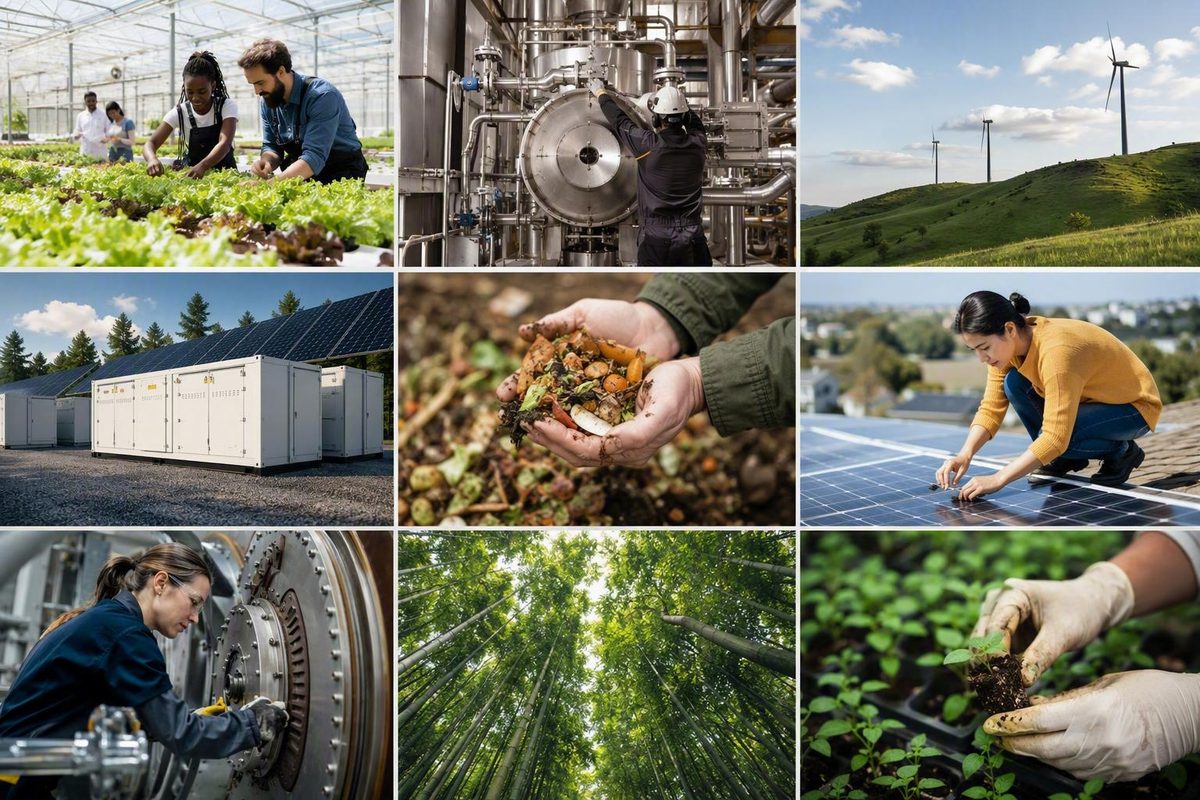
Green startup companies do not form a single industry. They include industrial-heat hardware, stationary batteries, solar-design software, food-surplus marketplaces, carbon-management systems, alternative packaging, soil analytics, mineral recovery, and recycling equipment.
That breadth makes direct comparison difficult. Software that helps installers design rooftop-solar projects follows a different path to market—and carries a different environmental evidence burden—from a thermal battery, carbon-removal plant, or fungi-based waste-treatment process.
This guide organizes 25 source-reported examples by the environmental problems they address. It is not a ranking. Inclusion means an editorial watchlist, conference profile, or sustainability directory identified the company as environmentally oriented and described a relevant core offering. It does not establish current operating status, verified impact, commercial readiness, profitability, or investment quality.
What qualifies as a green startup company?
For this article, a green startup company is an early-stage or scaling company whose core product or service is intended to address a material environmental problem.
That definition has two parts:
- The environmental problem must be central to the business. A company developing industrial heat storage, carbon-removal equipment, food-waste software, or recycling machinery fits more clearly than a conventional business that merely reduces its office energy use.
- The company should retain startup or scale-up characteristics. It may be developing technology, entering markets, expanding deployment, or building repeatable operations. No universal age, funding, revenue, ownership, or employee threshold appears across the supplied evidence.
This editorial definition is narrower than the general category of a sustainable business. Wolters Kluwer, for example, defines a sustainable business as one that balances profit with environmental and community health by reducing or eliminating negative effects from its operations. That broader framework can include an otherwise conventional company that improves sourcing, packaging, energy efficiency, and waste management.
The distinction matters. A manufacturer that installs efficient lighting may be operating more responsibly, but energy efficiency remains secondary to what it sells. By contrast, a company whose principal product controls building heat or sorts recyclable material has an environmental use case embedded in its offering.
The examples in this guide cover:
- Energy storage and distributed power
- Industrial heat, cooling, and fuel production
- Carbon capture, removal, storage, and conversion
- Solar deployment and electric-vehicle charging
- Building controls
- Agriculture and soil health
- Grocery and restaurant food waste
- Sustainable chemicals and packaging
- Lithium and rare-earth recovery
- Recycling and industrial-waste treatment
Their operating models are equally varied. Many combine categories, such as hardware with software or biotechnology with industrial processing.
The word startup is not applied consistently. TopStartups includes a company it labels post-IPO, while Built In’s greentech directories include organizations reporting hundreds or thousands of employees. Wellfound also includes a publicly traded charging company in its green category. Directory inclusion therefore cannot establish that an organization is privately held, early-stage, independent, or small.
This article uses “startup” as a practical discovery category rather than a legally or financially precise classification. The 25 companies are curated examples, not endorsements, investment recommendations, or claims that every organization remains active or operates today exactly as a directory describes it.
How the 25 companies were selected and how to read the evidence
Companies were included when a supplied editorial watchlist, conference profile, or sustainability directory:
- Identified the organization as green, climate, environmental, sustainability, or greentech oriented; and
- Described a core product or service directed at an environmental problem.
Duplicate appearances were consolidated. Recurrence can indicate editorial visibility, but it does not validate technology or impact. Biome Makers appears in two supplied editorial sources, while Solugen appears in three directories. Neither pattern proves superior performance.
The table uses seven model labels: hardware, software, infrastructure, service, marketplace, biotechnology, and hybrid. “Source status” identifies the type of evidence available; it does not describe the company’s commercial maturity.
| Company | Environmental problem | Offering | Model type | Source status |
|---|---|---|---|---|
| 3D Architech | Cooling energy and industrial efficiency | Micrometer-scale, 3D-printed metal heat-sink structures | Hardware | MIT-connected conference profile |
| Electrified Thermal Solutions | High-temperature industrial heat | Electrically conductive fire-brick thermal battery | Hardware | MIT-connected conference profile |
| Emvolon | Methane emissions and fuel production | Portable plants using repurposed engines as compressors and reactors | Hybrid | MIT-connected conference profile |
| Femto Energy | Transportable distributed power | Air-cooled nuclear-fission battery under development | Hardware | MIT-connected conference profile |
| EnerVenue | Stationary energy storage | Nickel-hydrogen battery systems | Hardware | Storm4 watchlist |
| CarbonCapture | Atmospheric carbon dioxide | Modular direct-air-capture units under development | Hardware | Storm4 watchlist |
| Noya | Atmospheric carbon dioxide | All-electric direct-air-capture system under development | Hybrid | MIT-connected conference profile |
| Helix Carbon | Industrial flue-gas emissions | Electrochemical capture and carbon-conversion system under development | Hardware | MIT-connected conference profile |
| Capture6 | Carbon capture and removal | Carbon-management solutions | Hybrid | Startup Savant profile |
| Twelve | Carbon utilization | Conversion of captured carbon dioxide into chemicals and fuels | Hybrid | Failory editorial profile |
| Aurora Solar | Rooftop-solar deployment | Remote design, modeling, and sales software | Software | Storm4 watchlist |
| Voltpost | Access to EV charging | Streetlight-mounted charging points | Infrastructure | Storm4 watchlist |
| ChargerHelp! | EV-charger reliability | Charger-maintenance software and workforce services | Hybrid | Storm4 watchlist |
| PassiveLogic | Building energy and operations | Building-autonomy platform | Software | Failory editorial profile |
| Runwise | Building-heating consumption | Hardware-software heating controls | Hybrid | Built In directory |
| Biome Makers | Soil health | Soil-DNA analytics and AI | Biotechnology | Two editorial directories |
| Afresh | Grocery produce waste | Predictive ordering and inventory tools | Software | Startup Savant profile |
| Too Good To Go | Surplus prepared food | Discount marketplace connecting consumers with food businesses | Marketplace | Startup Savant profile |
| Agreena | Agricultural emissions and practices | Carbon-farming and sustainability services | Service | Startup Savant profile |
| Solugen | Petrochemical feedstocks | Chemical production using renewable feedstocks | Biotechnology | Three third-party directories |
| PureLi | Lithium recovery | Modular recovery technology for low-concentration brines | Hardware | Storm4 watchlist |
| Allonnia | Rare-earth recovery | Protein-based recovery from mine-impacted water | Biotechnology | MIT-connected conference profile |
| AMP | Inefficient recyclable sorting | AI-assisted recycling-sorting hardware | Hybrid | Two third-party directories |
| Notpla | Single-use plastic packaging | Seaweed- and plant-derived packaging alternatives | Biotechnology | Startup Savant profile |
| Mycocycle | Industrial waste | Fungi-based treatment and production of biobased raw materials | Biotechnology | Built In directory |
Table note: Inclusion does not confirm current startup status, ownership, operating status, product availability, or commercial maturity.
The evidence is generally more useful for answering “What is this company trying to build?” than “How well does it work?” or “How much environmental benefit has it delivered?” The principal discovery sources are an unranked Storm4 watchlist, an MIT Sloan conference roundup, Startup Savant’s environmental-company profiles, and Failory’s greentech list.
Development-stage wording is particularly important. If a source says a company “is developing” a system, that does not establish that it commercially operates, deploys, or sells the system. This guide therefore avoids assigning labels such as pilot, early commercial, or scaled unless the evidence expressly supports them.
Funding, valuation, headquarters, headcount, stage, and hiring data are excluded from the main comparison because such details change quickly and are reported inconsistently. Solugen illustrates the problem: TopStartups reports a $350 million Series C and 51–100 employees, while Wellfound displays a 51–200 employee range. Storm4 provides yet another funding and employee snapshot. These differences may result from publication dates, definitions, or data methods, but the figures should not be treated as interchangeable.
Neither capital raised nor inclusion in several directories proves environmental impact, profitability, customer adoption, technical quality, or investment potential.
Energy and industrial decarbonization startups
Industrial climate technology targets physical systems such as heat, electricity, cooling, fuels, and storage. The five examples below illustrate substantially different products, but the supplied profiles do not provide a common set of independently validated performance or deployment metrics.
3D Architech uses lithography-based metal 3D printing to create heat-sink structures optimized at the micrometer scale. The proposed advantage is greater surface area and improved fluid flow. The MIT Sloan profile says the design cuts cooling electricity costs by almost 60% and increases green-hydrogen output by 30%. The same profile says Electrified Thermal Solutions is developing the Joule Hive Thermal Battery from electrically conductive fire bricks, producing gas temperatures up to 1,800°C, and attributes to the company a claim that its process is at least three times cheaper than producing hydrogen. These are profile-reported figures, not independently validated findings presented by this guide. MIT Sloan also reports that Femto Energy’s proposed system is designed to operate for three to 10 years without refueling.
Electrified Thermal Solutions proposes passing electricity through conductive bricks and then moving air or another gas through the heated material to supply high-temperature industrial processes. Relevant diligence questions include heat quality, duty cycle, electricity source, installation requirements, system integration, and the assumptions behind any cost comparison.
Emvolon repurposes internal-combustion engines as compressors and reactors in portable chemical plants intended to convert methane emissions into green methanol. Instead of moving methane to a central plant, the concept brings modular processing equipment closer to the emissions source. Its environmental case would depend on the methane’s counterfactual fate, plant energy use, conversion efficiency, leakage, methanol use, and lifecycle emissions.
Femto Energy is developing a transportable, air-cooled nuclear-fission battery intended for multi-year operation without refueling. The supplied profile does not establish commercial readiness or address lifecycle emissions, radioactive-waste management, licensing, security, decommissioning, or system safety. Low operational emissions and environmental superiority across a complete lifecycle are not equivalent claims.
EnerVenue commercializes nickel-hydrogen batteries for stationary energy storage. Storm4 characterizes the systems as long-life and non-flammable and reports more than $125 million in funding and approximately 100 employees. Those are third-party directory statements, not independent proof of longevity, safety, current company size, or deployment scale. Storm4 provides the underlying company description and figures.
These companies also illustrate different possible economic structures across industrial climate technology: equipment sales, system integration, licensing, service contracts, infrastructure deployment, and project-based revenue. The supplied sources do not establish the exact revenue mix of every company.
Industrial hardware raises questions less prominent in pure software businesses, including manufacturing yield, supply-chain resilience, site integration, permitting, construction, safety testing, technical validation, project finance, and working capital. That does not make hardware inherently weaker than software; it means readiness and scalability require sector-appropriate evidence.
Carbon capture, removal, and conversion companies
Carbon-management terminology can conceal important differences:
These pathways are not environmentally interchangeable.
CarbonCapture develops modular direct-air-capture units. Storm4 describes it as founded in Los Angeles in 2019 and reports a $35 million Series A, but those details are time-sensitive third-party snapshots. The source does not provide consistent evidence for capture efficiency, operating cost, energy demand, deployment scale, or durable storage outcomes.
Noya is developing an all-electric, interruptible, water-positive direct-air-capture system intended to release captured carbon dioxide for underground storage. “Developing” is essential: the supplied profile describes a proposed system but does not establish commercial deployment or performance at scale. Terms such as all-electric and water-positive also require defined boundaries, including the electricity source, water-accounting method, geography, and treatment of ancillary processes.
Helix Carbon is developing a modular electrochemical system intended to capture carbon dioxide from flue gas and convert it into industrial fuels or gases. Its input is a point-source exhaust stream rather than ambient air, and conversion into products differs from a pathway designed for durable underground storage.
Capture6 develops carbon-capture and removal solutions. Startup Savant reports $34.4 million in funding, but its profile does not provide independently verified environmental outcomes. The same source describes the agriculture and food-system companies discussed later in this guide. Startup Savant’s figures and descriptions are editorial, third-party reporting.
Twelve is described as converting captured carbon dioxide into chemicals and fuels. Failory reports $929.4 million in funding, but neither that figure nor the product description establishes current production volume, customer adoption, lifecycle emissions, or profitability. Both details come from Failory’s editorial company profile.
The central analytical distinction is between capturing carbon and removing it durably from the atmosphere. Point-source capture may prevent some new emissions from reaching the air. Direct-air capture targets carbon already in the atmosphere. Conversion incorporates captured carbon into products, while storage seeks to isolate it for a defined period.
A credible evaluation also requires information about:
- Energy and material inputs
- Upstream and downstream emissions
- The source of captured carbon
- Transport requirements
- Storage location and monitoring
- Expected permanence and reversal risk
- Product lifetime when carbon is converted
- Net removal after the full system is counted
- Actual deployment volume
The sources do not provide consistent, validated measurements of capture efficiency, cost per ton, permanence, or commercial scale. Ranking these companies numerically on those dimensions would imply comparability that the evidence does not support.
Climate software and lower-carbon infrastructure
Some green startup companies do not generate energy or remove carbon directly. They provide design, operations, maintenance, and control layers around physical assets. Their environmental contribution is generally indirect: helping customers deploy equipment, operate it more efficiently, or keep it available.
Aurora Solar provides software for remotely designing, modeling, and selling rooftop-solar projects. The platform can support installers’ site assessment, system design, and sales workflows, but it does not itself generate electricity. Useful evidence would connect software use to design accuracy, completed installations, enabled capacity, and customer retention.
Voltpost converts streetlights into electric-vehicle charging points. The model centers on reusing existing streetscape assets, but assessment must consider installation permission, electrical capacity, accessibility, charger availability, interoperability, maintenance, utilization, and local curb-management rules.
ChargerHelp! combines software with workforce services intended to improve EV-charger uptime. Relevant evidence would include repair response times, repeat-failure rates, geographic coverage, customer retention, and uptime measured under a defined method.
PassiveLogic is described as a building-autonomy platform. Building-control benefits depend on building type, existing equipment, baseline operations, commissioning quality, and whether modeled savings are visible in meter data. Failory’s reported $154.2 million funding total is financing information, not evidence of adoption or energy savings.
Runwise combines hardware and software to control building heating. Its Built In listing says the platform operates in more than 2,000 buildings in the northeastern United States and reduces energy use, costs, and carbon output. Those are directory or company-description claims rather than independently verified findings. Built In provides the underlying Runwise description and deployment figure.
Together, these companies represent four different roles:
- Design: Aurora Solar supports solar-project planning and sales.
- Deployment: Voltpost adds charging capability to physical infrastructure.
- Maintenance: ChargerHelp! combines software and field services.
- Operations: PassiveLogic and Runwise address building control.
Software can be environmentally consequential without directly handling electrons or carbon dioxide. Its impact should nevertheless connect to measurable physical outcomes. A dashboard login, modeled estimate, or installation count is not necessarily equivalent to verified avoided energy use or emissions.
Agriculture and food-system startups
Agriculture and food waste require different tools and evidence. Soil analytics operate at the field level; grocery-ordering software affects inventory decisions; surplus-food marketplaces depend on merchants and consumers; and carbon-farming services work through farmer adoption and accounting systems.
Biome Makers uses soil-DNA analytics and AI to assess or monitor soil health. It appears in both Storm4 and Startup Savant, indicating visibility across two editorial sources rather than proof that its technology, funding, or impact is superior. Monitoring is not itself an improved soil outcome: evaluation should distinguish analytical accuracy, use of recommendations, practice changes, and measured changes in soil properties.
Afresh provides predictive ordering and inventory tools intended to reduce grocery produce waste. Its business customer is generally a grocer rather than the end consumer. Relevant measures could include changes in shrink, spoilage, stockouts, gross margin, and discarded produce against an appropriate baseline.
Too Good To Go operates a marketplace connecting consumers with discounted surplus food from participating restaurants, bakeries, grocers, and other food businesses. Marketplace activity can be counted in meals or packages sold, but environmental assessment requires a counterfactual: whether the food would otherwise have been discarded and whether the transaction displaced another purchase.
Agreena provides carbon-farming and agricultural sustainability services. Evaluation should examine practice definitions, farmer participation, sampling methods, model assumptions, additionality, permanence, leakage, data ownership, and treatment of reversals.
These models require different impact measures:
- Analytics: accuracy, decision usefulness, adoption, and measured soil outcomes
- Enterprise software: avoided spoilage against a defined inventory baseline
- Marketplace: verified surplus redistributed and its likely alternative destination
- Agricultural services: practice durability and credible soil or emissions accounting
The supplied profiles describe intended benefits but do not consistently verify those outcomes. Reported funding should therefore remain context, not an impact score.
Sustainable materials, mineral recovery, and circular-economy companies
Materials and circular-economy startups intervene at different points in a product lifecycle: feedstock selection, chemical production, mineral extraction, packaging design, waste sorting, and treatment of industrial residues.
Solugen uses renewable feedstocks such as corn sugar in chemical production through its Bioforge platform. It appears in Storm4, TopStartups, and Wellfound, although the directories report differing funding and employee figures. The important environmental question is not which snapshot is newest, but whether the production pathway improves performance against a defined incumbent process. That requires evidence about feedstocks, land and water demands, process energy, yield, toxicity, transport, product performance, and end-of-life behavior.
PureLi develops modular lithium-recovery technology for low-concentration brines. The source uses development-stage language, so the system should not be described as commercially established. The supplied evidence does not support claims about recovery rate, energy intensity, water use, operating cost, or environmental superiority.
Allonnia uses lanmodulin—a protein attached to beads—to recover rare-earth elements from mine-impacted water. MIT Sloan reports that the protein can be reused for up to 10 cycles. That is a profile-reported technical detail, not an independently reproduced result. The environmental case also depends on concentration levels, selectivity, yield, protein and bead production, regeneration, waste streams, and treatment of the remaining water.
AMP combines AI and hardware to sort recyclable materials. Startup Savant and TopStartups both profile the company, but their company details differ and neither independently verifies diversion or recovery outcomes. Sorting performance depends on incoming material, contamination, facility configuration, equipment uptime, downstream buyers, and whether recovered material displaces virgin production.
Notpla develops seaweed- and plant-derived alternatives to single-use plastic packaging. The environmental case cannot be inferred from the feedstock description alone. Comparison with incumbent packaging should cover functional performance, inputs, additives, manufacturing energy, shelf life, transport weight, food protection, disposal infrastructure, and degradation conditions.
Mycocycle uses fungi to treat industrial waste and create biobased raw materials, according to its Built In company description. The directory does not independently verify toxin-removal performance or output quality. Customers would need contaminant-specific results, process time, throughput, handling requirements, residual-waste characterization, worker protections, and evidence that outputs meet their intended applications. Built In supplies the underlying company description.
These examples span several models:
- Biotechnology: Solugen, Allonnia, Notpla, and Mycocycle use biological feedstocks, proteins, organisms, or bio-inspired processes.
- Advanced materials: Notpla develops packaging with different feedstock and disposal assumptions.
- Recovery hardware: PureLi targets lithium extraction from dilute resources.
- Recycling systems: AMP combines sensing, machine intelligence, and sorting machinery.
None should be described categorically as clean, harmless, or zero-waste. Materials and recovery systems require lifecycle evidence covering material inputs, energy, yields, durability, toxicity, transport, residuals, and end-of-life outcomes.
How to evaluate a green startup beyond the label
A green label signals the category a company seeks to occupy. It does not show that the problem is material, the technology works, customers will pay, or the claimed environmental advantage survives lifecycle analysis.
A practical review can use seven lenses.
1. Environmental materiality
Start with the company’s reason to exist:
- What environmental problem does the core offering address?
- Is that problem material in the target market?
- Is sustainability central to revenue or peripheral branding?
- Does revenue growth plausibly increase the intended benefit?
- Could growth create significant offsetting harms?
A conventional company can operate responsibly without being a green startup. Conversely, a climate-focused company can still create environmental costs. The relevant question is whether the product addresses a significant problem and whether the proposed benefit is material relative to its footprint.
2. Technical readiness
Ask what exists today rather than what the roadmap promises.
Potential readiness categories include:
- Concept or laboratory system
- Integrated prototype
- Field pilot
- Commercially available product
- Repeat deployment
- Scaled operation
Assign those labels only when supported by evidence. A conference profile saying that a system “is developing” does not establish a commercial installation. Stronger evidence may include test reports, site documentation, regulatory approvals, commissioning records, production facilities, customer references, or independently observed operation.
Hardware buyers should also examine manufacturability, component availability, integration, maintenance, warranties, and failure modes. Software buyers should test data quality, workflow fit, interoperability, security, and model performance outside demonstrations.
3. Measurable environmental impact
Ask for an explicit chain from activity to outcome:
- Baseline: Compared with what?
- System boundary: Which upstream and downstream effects are included?
- Functional unit: Per ton, package, building, kilowatt-hour, acre, or another unit?
- Time period: Over what operating life?
- Deployment volume: How many systems, sites, or transactions?
- Measured result: Energy, emissions, waste, water, pollution, or another outcome?
- Verification: Company model, customer data, audit, certification, or peer-reviewed work?
Lifecycle effects are especially important for batteries, fuels, nuclear systems, carbon capture, alternative materials, and mineral recovery. Operational performance alone may omit extraction, construction, transport, replacement, land use, waste, or end-of-life treatment.
4. Commercial traction
Funding is an input, not an operating outcome. Look instead for:
- Paying customers
- Repeat purchases or renewals
- Operating installations
- Contracted projects
- Production facilities
- Utilization
- Revenue quality
- Customer concentration
- Geographic reach
- Retention or repeat use
The right evidence depends on the model. A marketplace needs local liquidity and repeat transactions. Industrial equipment needs reference sites and reliable operation. A project developer needs permits and finance. Enterprise software needs adoption and retention. A service company needs workforce quality and repeatable delivery.
5. Business model
Identify who pays, what they buy, and why the economics work.
Possible models include equipment sales, subscriptions, usage fees, transaction commissions, licensing, project ownership, maintenance contracts, commodity sales, carbon-credit revenue, or combinations of these.
Then test whether customers receive sufficient value without relying entirely on an environmental premium. Cost savings, reliability, compliance, risk reduction, product performance, and new revenue may matter as much as sustainability.
Revenue and environmental impact should also be examined together. If a recycling company is paid per ton processed, does the recovered material reach a productive end market? If a carbon platform earns transaction fees, does higher volume represent additional climate benefit? Incentive alignment deserves explicit scrutiny.
6. Scalability and operational constraints
“Scalable” should mean more than technically repeatable. Consider:
- Manufacturing capacity and yield
- Critical-material requirements
- Skilled-labor availability
- Site and infrastructure needs
- Interconnection or transport constraints
- Permitting timelines
- Customer implementation burden
- Supply-chain concentration
- Working-capital needs
- Geographic limitations
- Maintenance and end-of-life obligations
Software may distribute quickly, but its impact can remain constrained by slow-moving physical assets. Hardware may produce direct physical effects, but each deployment can require manufacturing, construction, permitting, and financing.
7. Regulatory, safety, and claims risk
Risk differs by sector. Nuclear systems, chemicals, carbon storage, mining, grid equipment, food products, waste processing, and charging infrastructure face different approval and safety obligations.
Examine:
- Required approvals and permits
- Product and worker safety
- Environmental liabilities
- Data and accounting standards
- Resource or land rights
- Long-term monitoring obligations
- Waste ownership
- Insurance
- Claims substantiation
Certifications can create a defined assessment process and offer useful trust signals. They do not prove that every product, supplier, facility, or company operation is sustainable.
Environmental marketing should be specific and substantiated. Wolters Kluwer notes that the US Federal Trade Commission’s Green Guides address potentially unfair or deceptive environmental marketing claims. A measured reduction against a named baseline is generally more informative than broad labels such as green, eco-friendly, or sustainable. The Wolters Kluwer guide provides the underlying regulatory reference and cautions businesses to substantiate environmental claims.
Before investing, buying, applying for a job, or forming a partnership, ask:
- What problem does the company solve?
- What is the comparison baseline?
- What result has been measured?
- At what deployment scale and over what period?
- Who verified the result?
- What lifecycle, safety, resource, or regulatory tradeoffs remain?
- How does the business make money?
Green startup companies are best compared by their environmental problem, solution type, technical maturity, business model, and quality of impact evidence—not by capital raised or promotional labels.
Frequently asked questions
What is a green startup company?
A practical definition is an early-stage or scaling company whose core product or service is intended to address a material environmental problem. The category can include hardware, software, infrastructure, services, marketplaces, biotechnology, and hybrid models.
There is no universal age, employee, revenue, ownership, or funding threshold. The label is most useful when environmental purpose is central to the offering rather than a secondary operational initiative.
Which sectors contain the most visible green startup activity?
The supplied lists show activity across energy storage, industrial heat, carbon management, solar, EV charging, building controls, agriculture, food waste, chemicals, packaging, critical-mineral recovery, and recycling.
Visibility reflects what directories and editorial watchlists choose to cover. It is not a reliable measure of which sector has the most companies, capital, deployments, or environmental impact.
Does venture funding prove that a green startup is successful or environmentally beneficial?
No. Funding indicates that investors supplied capital under particular terms at a particular time. It does not prove profitability, revenue quality, customer retention, technical readiness, environmental impact, or investment quality.
Figures can also differ because of publication dates, currencies, round definitions, debt treatment, or data errors. Commercial and environmental diligence should rely on relevant operating evidence rather than capital raised.
How can readers tell whether a company’s environmental claims are credible?
Look for a specific baseline, clear system boundary, appropriate functional unit, stated time period, deployment volume, measured result, and verification method. Ask whether upstream and downstream lifecycle effects are included and whether results come from company models, customer data, audits, certifications, or independent research.
Broad labels deserve more skepticism than narrow, measurable claims. Certifications can help, but no certification automatically validates every company practice or product.
Why do some green-startup directories include public or mature companies?
Directories use different inclusion rules. Some classify companies by industry tag, self-description, hiring category, investor interest, or broad sustainability relevance rather than by age, size, or ownership.
Consequently, a green-startup page may include public companies or organizations with hundreds or thousands of employees. Use directories for discovery, then verify ownership, operating status, company maturity, and environmental relevance separately.
Founder note: Lunera says it partners early with technical founders and accepts direct pitches without a warm introduction. Its stated interests include developer tools, data infrastructure, applied AI, and other foundational software. The supplied information does not identify Lunera as a climate-focused investor.